Target Company URL Research: A Complete Guide to Finding and Verifying Business Websites

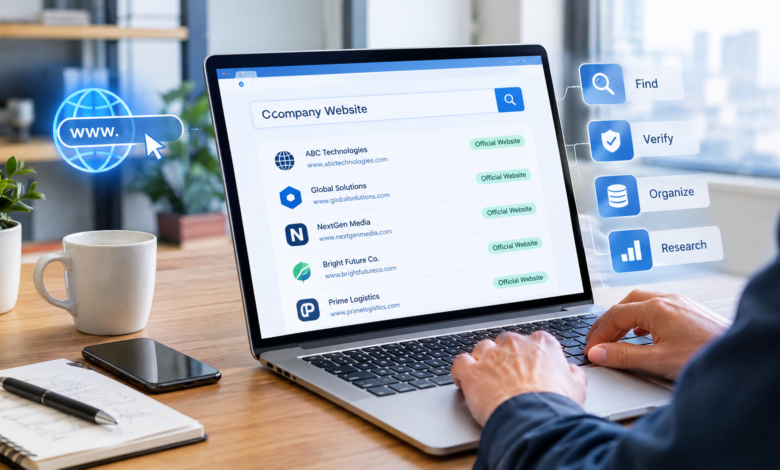
A company URL can become the foundation for collecting additional business information. However, simply finding a website with a similar company name is not enough. Researchers need to check the company identity, location, industry, products, services, and other reliable signals before confirming a domain.
What Is Target Company URL Research?
Target company url research is the process of finding a possible official website for a specific company and then verifying whether that website belongs to the intended organization.
The basic workflow can be summarized as:
Company Name → Find Possible URL → Verify Website → Collect Business Data → Use Information
For example, a researcher may have a spreadsheet containing hundreds of business names but no website addresses. Instead of manually searching without a structured process, target company url research can help identify likely domains and organize them for further verification.
The objective is to find the correct official domain, rather than simply selecting the first website that appears in search results.
Why Is Target Company URL Research Important?
A company domain can serve as a digital identity for an organization. Once the correct URL has been identified, it can support several types of research, including:
- Sales prospecting
- Lead generation
- SEO competitor research
- Recruitment
- Market research
- Account-based marketing
- CRM enrichment
- Business intelligence
- Digital PR
- Partnership research
- Investment research
- Supplier research
Incorrect domain selection can create problems throughout a research database. If two companies have similar names, selecting the wrong website could result in incorrect information about their industry, location, products, employees, leadership, competitors, or contact details.
That is why target company url research should focus on accuracy as well as speed.
How Does Target Company URL Research Work?
A reliable process combines automated discovery with human verification. Automation can handle large lists quickly, while human judgment is valuable when company names are unclear or businesses have changed their identities.
1. Create a Company List
Begin by collecting the businesses you want to investigate. A useful spreadsheet may include:
| Company | Country | Industry | URL | Status |
|---|---|---|---|---|
| Example Company A | USA | Software | Pending | Research |
| Example Company B | India | Manufacturing | Pending | Research |
| Example Company C | UK | Finance | Pending | Research |
Country and industry information can make matching easier, especially when several organizations use similar names.
2. Clean Company Names
Good target company url research starts with clean information. Remove unnecessary legal suffixes such as LLC, Inc., Ltd., Limited, PLC, LLP, GmbH, or Pvt. Ltd. when appropriate.
Also check for spelling mistakes, duplicate records, abbreviations, previous business names, and parent-subsidiary relationships.
However, do not remove words that are genuinely part of the company’s brand.
3. Search for Possible Domains
The next stage is finding likely websites. Manual searches can include the company name together with:
- Country
- City
- Industry
- Product
- Founder
- “Official website”
For example, searching for a company name alongside its country and industry is generally more useful than searching for the name alone.
Manual research works well for smaller lists, while automated lookup systems can save time when hundreds of companies need to be processed.
4. Review Match Confidence
Some tools provide match, similarity, or confidence scores. These scores can help researchers prioritize records for review.
A very high match may require quick verification, while medium or low matches may need more detailed investigation.
A score should never be considered final proof. Similar company names can produce apparently strong matches even when the organizations are different.
How to Verify an Official Company Website
Verification is one of the most important stages of target company url research.
Check the Company Name
Compare the name shown on the website with the business you are researching. Small differences, such as a legal suffix being omitted, may be normal.
Review Branding
Look at the logo, visual branding, and other identity information. Compare these details with reliable information already available about the company.
Read the About Page
The About page may provide information about:
- Company history
- Industry
- Mission
- Headquarters
- Founders
- Services
- Markets served
Check Contact Information
Review the Contact page for business addresses, telephone numbers, and company email addresses. The location should be consistent with the organization being researched.
Review Products and Services
The company name alone is not sufficient. If your target is a logistics company but the website describes accounting software, the domain may belong to a different organization.
Examine Legal Pages
Privacy policies, terms of service, copyright notices, and other legal information can reveal the company’s registered or trading identity.
Using First-Party Evidence
Strong target company url research relies heavily on first-party information. Useful sources can include the official website, About page, Contact page, careers section, press room, investor relations pages, privacy policy, terms and official company announcements.
Third-party directories can help with discovery, but their information may be outdated or incorrect. Important company records should therefore be checked against current first-party sources whenever possible.
Dealing With Similar Company Names
Similar names are a common challenge. A company name such as “Mercury” could refer to organizations in technology, finance, insurance, manufacturing, retail, or other industries.
Adding identifying information can make target company url research much more accurate. Useful details include:
- Country
- City
- Industry
- Product
- Founder
- Parent company
- Employee size
The more context available, the easier it becomes to distinguish between organizations with similar names.
Regional Domains, Rebrands, and Domain Changes
International companies may operate through a global domain, country-specific domain, regional subdomain, language-specific folder, or separate product website.
For broad corporate research, the primary global domain may be the most useful. For local sales, SEO, recruitment, or market research, a regional URL may also be important.
Companies can also rebrand, merge, become acquired, change domains, redirect old websites, or shut down. Researchers should investigate these changes instead of automatically treating an old domain as the current official website.
Target Company URL Research for Sales and SEO
Sales teams can use verified domains to study products, industries, company announcements, careers, and integrations before contacting prospects. This can make outreach more relevant.
SEO professionals can use verified domains for competitor research, keyword-gap analysis, backlink research, content research, digital PR, and link prospecting.
However, discovering a company URL and performing detailed SEO analysis are separate activities. A domain lookup identifies the website, while dedicated SEO tools can be used for rankings, keywords, backlinks, and traffic analysis.
Target Company URL Research for Recruitment and Market Research
Recruiters can begin with the official company website and follow links such as Careers, Jobs, Join Us, Work With Us, Opportunities, or Vacancies. Some companies use external applicant-tracking systems, so starting from the official website helps establish a reliable path.
Market researchers can also use verified websites to study products, pricing, geographic presence, customer segments, partnerships, leadership, expansion plans, launches, and company positioning.
Common Mistakes to Avoid
During target company url research, avoid these common mistakes:
- Choosing the first search result without verification.
- Ignoring country and geographic information.
- Treating confidence scores as proof.
- Overlooking redirects.
- Confusing parent companies with subsidiaries.
- Depending completely on outdated directories.
- Importing unverified information into a CRM.
These errors can reduce the quality of sales, marketing, recruitment, and research databases.
How AI Can Help
AI can make target company url research faster by helping clean company names, identify duplicates, compare similar organizations, classify companies, discover likely domains, summarize websites, and flag uncertain matches.
However, AI should not automatically be treated as the final authority. It can make incorrect associations or confuse organizations with similar names. Important results should still be checked against current first-party information.
Best Practices for Accurate Research
A strong target company url research workflow should:
- Start with clean company names.
- Include country and industry information.
- Consider multiple possible domains.
- Visit the website before confirmation.
- Check About and Contact pages.
- Review products and services.
- Investigate redirects.
- Flag uncertain matches.
- Record verification dates.
- Recheck important records periodically.
For high-value records, using two or three independent identity signals before confirming a domain can provide additional confidence.
Final Thoughts
Target company url research may seem simple, but identifying the right business website is an important foundation for reliable company data. A wrong domain can lead to incorrect information about products, employees, markets, competitors, and contacts.
The most effective approach combines automated discovery with careful human verification. Automation is useful for large lists, while human review is especially important for similar names, regional websites, subsidiaries, rebrands, acquisitions, and redirects.
When target company url research is performed consistently, it can support cleaner CRM records, stronger sales intelligence, more accurate SEO research, better recruitment research, and dependable market analysis.
FAQs
1. What is Target Company URL Research?
Target company url research is the process of finding and verifying the official website belonging to a particular business.
2. How can I find a company’s official website?
Search the company name with its location, industry, product, or “official website,” then verify the result using its About, Contact, product, and legal pages.
3. Can company URLs be found in bulk?
Yes. Automated company-domain lookup services can process large lists and provide potential domains for review.
4. Are company URL lookup tools always accurate?
No. Automated tools can confuse similar businesses or return outdated domains, so verification remains important.
5. Why is Target Company URL Research useful for SEO?
Verified domains can help SEO professionals begin competitor research, keyword-gap analysis, backlink research, content research, and link prospecting.
6. Can recruiters use company URL research?
Yes. Recruiters can use verified company websites to locate official Careers, Jobs, and employment information.
7. What should I do when two companies have the same name?
Add information such as country, city, industry, product, founder, or parent company to distinguish the organizations.
8. What happens when a company changes its domain?
Investigate whether the company rebranded, merged, was acquired, or simply migrated its website. Then update the database appropriately.
9. Can AI help with company URL research?
Yes. AI can assist with matching, classification, duplicate detection, summarization, and domain discovery, but important results should still be verified.
10. How can company URL databases stay accurate?
Record verification dates and statuses, investigate redirects and rebrands, remove duplicates, and periodically recheck important company records.